

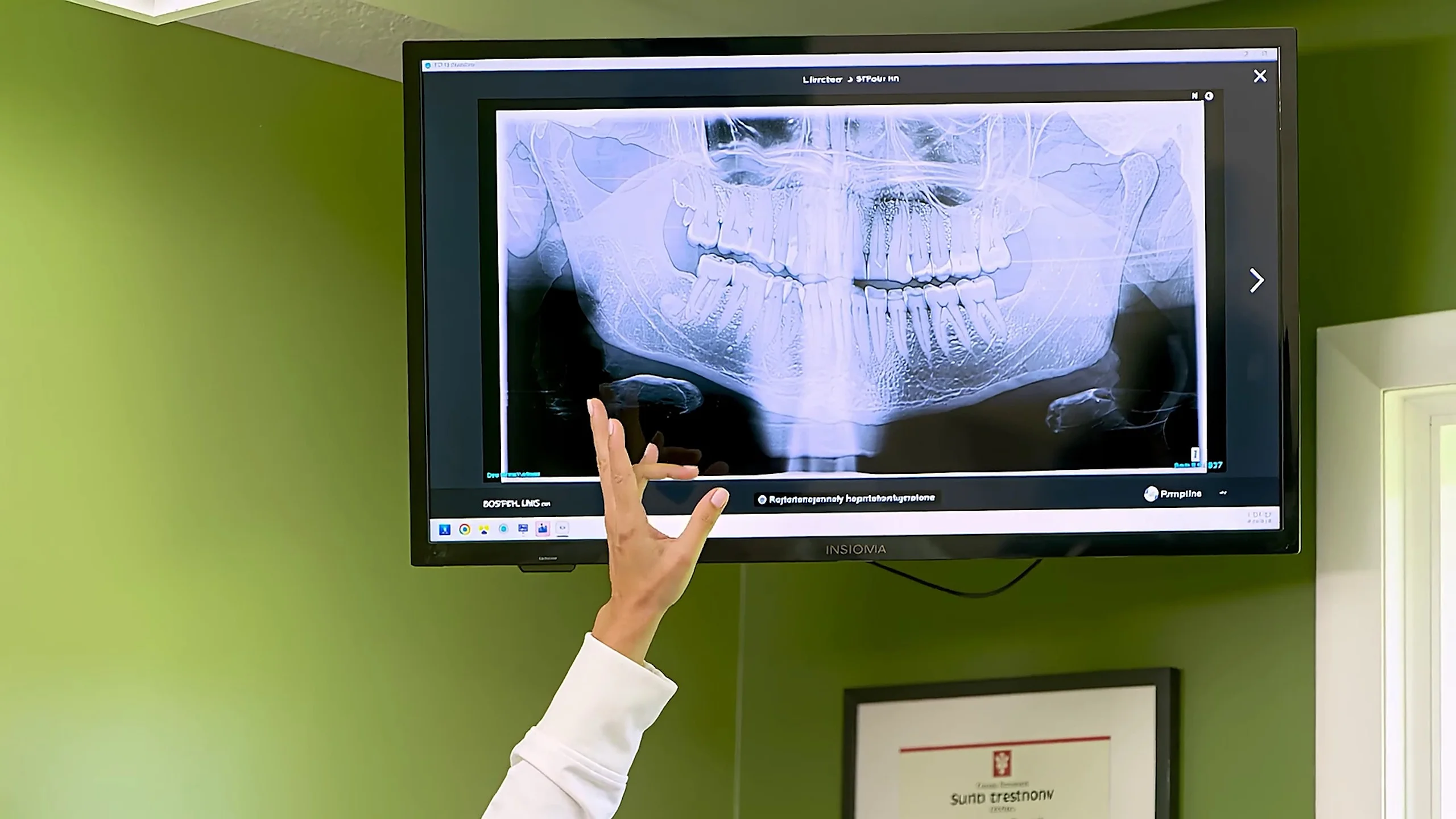
Dental radiographs (X-rays) show what a regular exam can’t. Your dentist and hygienist use them to find hidden problems early, while they’re still small, and to plan treatment accurately. Without X-rays, problem areas can go undetected. If you’ve ever wondered whether they’re worth it, or whether they’re safe, here’s what they do, how little radiation they involve, and how your dentist decides when you need them.
What can dental X-rays reveal?
An X-ray passes a focused beam through the teeth and bone and produces the familiar black-and-white image your dentist reads. Without an X-ray of the whole tooth and its supporting bone and gums, there’s no real way to detect infection or other disease hiding beneath the surface.
Dental X-rays may reveal:
- Abscesses or cysts
- Bone loss
- Cancerous and non-cancerous tumors
- Decay between the teeth
- Developmental abnormalities
- Poor tooth and root positions
- Problems inside a tooth or below the gum line
Finding and treating these early can save you time, money, unnecessary discomfort, and your teeth.
Why take X-rays if nothing hurts?
Many of the problems X-rays catch give no warning at all. Large cavities can be very painful, but tiny ones may not be felt, and cavities that form between the teeth can’t be seen with the naked eye. X-rays and the dentist’s trained eye find even the smallest cavities so they can be treated before they get worse.
The same is true of cracks. Some cracked teeth are clearly visible, but others show up only on an X-ray. Learn more about a cracked tooth and why it can hurt one moment and feel fine the next.
Gum disease is another quiet one. During a periodontal exam, your dentist or hygienist measures the pocket between each tooth and the gums. As periodontal disease progresses, those pockets deepen and bone loss may follow, from slight to severe. Routine X-rays show the extent of bone and gum recession and point to areas that may need attention in the future. See how the stages are diagnosed.
Waiting for symptoms costs more. A cavity left alone erodes deeper into the tooth, a crack left untreated can permanently damage the pulp, and advanced gum disease can loosen teeth until they’re lost. Catching these on an X-ray first can mean saving a tooth that could otherwise have been lost.
Are dental X-rays safe?
We’re all exposed to natural radiation every day. A full-mouth series of dental X-rays exposes you to about the same amount you’d get in a single day from natural sources.
Dental X-rays produce a low level of radiation and are considered safe. Lead apron shields protect the rest of the body, and modern equipment keeps each exposure short.
How do you keep my exposure low?
Dentists take the necessary precautions to limit your exposure every time an X-ray is taken:
- Lead apron shieldsCover and protect the body.
- Modern, fast filmCuts down the exposure time of each X-ray.
- X-rays are taken when they’re neededNot on a fixed routine for everyone. Your dentist and hygienist base the decision on your own health and history, as the next question explains.
How often do I need dental X-rays?
It depends on your own dental health. Your dentist and hygienist recommend X-rays based on your medical and dental history, your exam, any symptoms, your age and your risk of disease.
- New patientsUsually have a full-mouth series, which is typically good for three to five years.
- At check-upsBite-wing X-rays (the top and bottom teeth biting together) are usually taken once or twice a year to catch new problems.
Do children need dental X-rays?
For children, dental X-rays are used only when the dentist suspects cavities or orthodontic problems. They’re often the only way to spot tiny cavities in baby teeth. A child may feel no pain at all, but left unchecked those small cavities can grow into larger ones and lead to decay and childhood periodontal disease. Read more about how often children should have check-ups.
Are X-rays part of every check-up?
Reviewing your X-rays is one part of a regular check-up exam. Along with it, your dentist and hygienist will:
- Screen for oral cancer, checking the face, neck, lips, tongue, throat, tissues and gums
- Evaluate the gums and bone around the teeth for signs of gum disease
- Check every tooth surface for decay
- Look over your existing fillings, crowns and other restorations
Many health problems show up first at the dentist, and a thorough exam of the whole mouth is how they’re caught early. X-rays, along with regular exams, cleanings, fluoride and sealants, are part of preventive dentistry that keeps small problems small.
Read more about dental X-rays and what happens at your exam and cleaning.